
In 60 seconds: Americans vote for president, but electors actually elect the president — 538 of them, and 270 wins. Here's how that system works, why two states split their votes, and how a candidate can win the White House while losing the national popular vote.
- The Electoral College has 538 electors: 435 House seats + 100 senators + 3 for Washington, D.C. A candidate needs 270 — a majority — to win.
- Your vote helps pick your state's electors, not the president directly. In 48 states and D.C., the statewide winner takes all of that state's electors.
- Maine and Nebraska are the exceptions: they award two electors to the statewide winner and one per congressional district won.
- If nobody reaches 270, the House of Representatives picks the president, with each state delegation casting one vote.
- The current electoral map, based on the 2020 census, stays in place through the 2028 election.
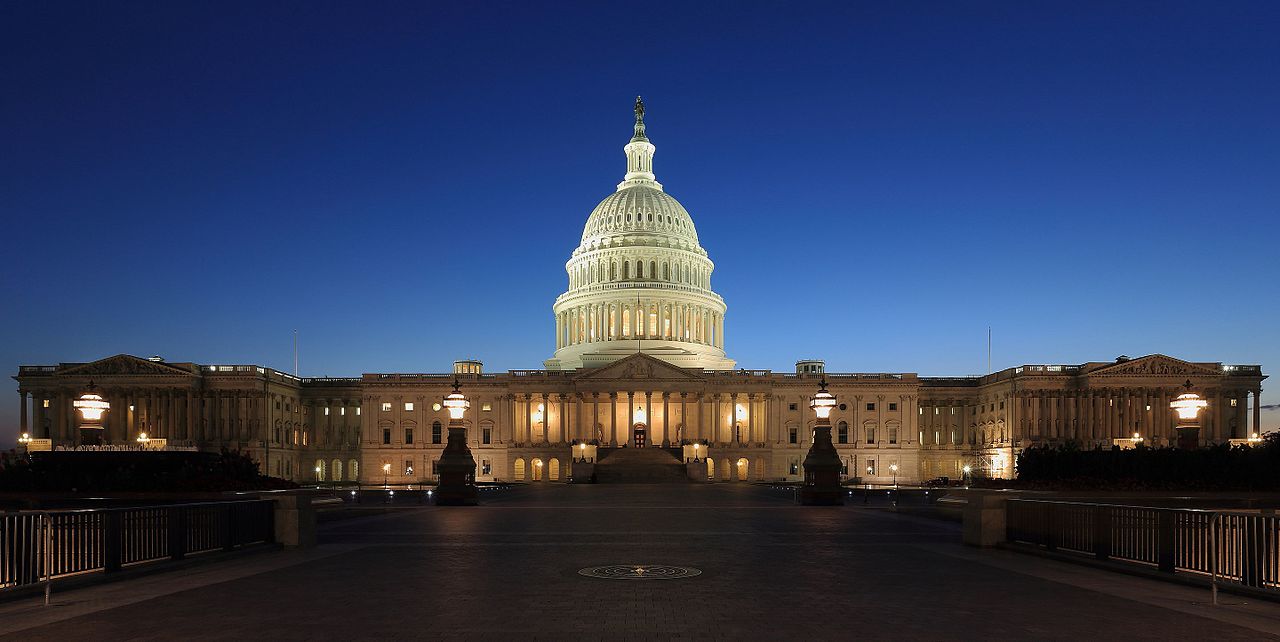
The U.S. Capitol at dusk. Congress counts the electoral votes in January after each presidential election. Photo: Wikimedia Commons.
Every four years, someone asks the same question on election night: how can a candidate win the presidency without winning the most votes nationwide? The answer is older than the country itself, and it's sitting right there in the Constitution. The United States doesn't hold one national election for president. It holds 51 separate ones — one in each state, plus D.C. — and the winners of those contests send electors to do the actual choosing.
What the Electoral College actually is
Article II, Section 1 of the Constitution creates the system, and the 12th Amendment (ratified in 1804) rewired it so electors cast separate ballots for president and vice president. Here's the chain, step by step: on Election Day, voters in each state pick a slate of electors pledged to a candidate. Those electors meet in their state capitals in December and cast the formal votes. Congress then counts those votes in January, and the candidate with at least 270 electoral votes becomes president.
That "pledged" part matters. Electors are real people — usually party loyalists picked by the state parties — and in most states they're legally bound to vote for the candidate who won their state. The Supreme Court ruled in 2020 that states may punish so-called faithless electors who break that pledge, which is why faithless votes are vanishingly rare today.
How the 538 votes are divided
The math is simple once you see it. Each state gets electors equal to its representation in Congress: two senators plus its House members, which are apportioned by population after each census. Add Washington, D.C.'s three electors (granted by the 23rd Amendment), and you get 435 + 100 + 3 = 538. A majority of 538 is 270, which is why "270 to win" is the phrase you hear all night on election night.
The House has been capped at 435 seats for more than a century, so the only thing that moves the map is the census. After the 2020 census, big states shifted a little — California dropped from 55 to 54, Texas rose from 38 to 40, Florida went from 29 to 30, and New York slipped from 29 to 28 — and that map stays in place through the 2028 election.
| State | Electoral votes | How they're awarded |
|---|---|---|
| California | 54 | Winner-take-all |
| Texas | 40 | Winner-take-all |
| Florida | 30 | Winner-take-all |
| New York | 28 | Winner-take-all |
| Maine | 4 | District method |
| Nebraska | 5 | District method |
| Smallest states + D.C. (e.g. Wyoming, Vermont, Alaska, Delaware) | 3 each | Winner-take-all |
Why Maine and Nebraska split theirs
Winner-take-all is a state choice, not a constitutional requirement — and two states chose differently. Maine and Nebraska use the congressional district method: the winner of each congressional district gets one elector, and the statewide winner gets the other two (the Senate-based electors).
That's why you sometimes see a single electoral vote from Maine or Nebraska go to the candidate who lost the state overall. Maine's rural 2nd district voted for Donald Trump in 2016, 2020, and 2024, while Nebraska's Omaha-based 2nd district went for Barack Obama in 2008 and Joe Biden in 2020. Both states have debated going back to winner-take-all, and neither has — which is why those single votes still get their own headlines every cycle.
Why the popular vote winner can still lose
Here's the part that trips people up, and it's pure arithmetic. Because 48 states award all their electors to the statewide winner — even by a single vote — a candidate can pile up huge margins in states they win easily and still lose the electoral count. Winning California by 5 million votes earns the same 54 electors as winning it by 5,000.
It's happened twice in modern times: in 2000, George W. Bush won the Electoral College while Al Gore won the national popular vote, and in 2016, Donald Trump won the Electoral College while Hillary Clinton won the national popular vote. Both times the result was decided by razor-thin margins in a handful of states — which is exactly why campaigns spend almost all their time and money in swing states and almost none in states neither side can lose.
That swing-state focus is the system's most-criticized feature, and also its most durable one. Changing it would take either a constitutional amendment or the National Popular Vote Interstate Compact — an agreement among states to award their electors to the national popular-vote winner — reaching the 270-vote threshold needed to take effect. It hasn't reached that threshold, so the Electoral College decides every presidential election for now.
What happens if nobody reaches 270
A tie at 269–269, or a three-way split where nobody gets a majority, sends the election to the House of Representatives under the 12th Amendment. And this is not a normal House vote: each state delegation casts a single vote, so Wyoming's one representative counts the same as California's 52. The Senate, meanwhile, picks the vice president, with each senator voting individually.
It's only happened once under the current system — in 1824, when the House picked John Quincy Adams over Andrew Jackson, who had won the most popular and electoral votes but not a majority. The Electoral Count Reform Act of 2022 tightened the certification and counting rules after the 2020 disputes, but it did not replace the Electoral College itself.
What happens next
For voters, the practical takeaway is timing. Presidential elections aren't decided by a single national count — they're decided state by state, which is why some races get called on election night and others take days while mail ballots are counted and canvassed. If you want the full picture on that, read our explainer on how U.S. votes get counted — and why some races take days to call.
Looking ahead, the next real shift in the map comes after the 2030 census, when House seats — and therefore electors — get reapportioned again. Until then, the 2020 map rules: 538 electors, 270 to win, and a handful of swing states deciding who gets there. Love it or hate it, that's the game every presidential campaign is actually playing.
Frequently asked questions
Do voters elect the president directly? No. Voters pick electors pledged to a candidate, and the electors formally elect the president and vice president.
How many electoral votes does it take to win? 270 — a majority of the 538 total electors.
Which states don't use winner-take-all? Only Maine and Nebraska. They award two electors to the statewide winner and one to the winner of each congressional district.
Can an elector vote for someone else? In most states, no — electors are bound by state law, and the Supreme Court ruled in 2020 that states may penalize faithless electors.
What happens in a 269–269 tie? The House of Representatives elects the president, with each state delegation casting one vote; the Senate elects the vice president.
Related reading: How US Votes Get Counted — and Why Some Races Take Days to Call and Alaska's Governor Just Ordered a Probe Into the 'Second Dan Sullivan'.
Sources: U.S. Constitution, Article II, Section 1 and the 12th Amendment; 23rd Amendment (D.C. electors); National Archives Electoral College materials; Electoral Count Reform Act of 2022; Supreme Court, Chiafalo v. Washington (2020); 2020 census apportionment figures (California 54, Texas 40, Florida 30, New York 28).