
In 60 seconds: Spain's Urda train crash toll has risen to 69, and the investigation has narrowed to 17 minutes: a signalling failure stopped six trains, controllers cleared the Renfe express to restart at normal speed at 8:36 a.m., and at 8:53 a.m. it hit the stationary Iryo train ahead of it.
- Official toll now 69, up from 68 — confirmed Thursday by Castilla-La Mancha president Emiliano García-Page after another body was recovered Wednesday night.
- The rail investigation commission briefly posted 74 in its case file, then corrected it to 69; officials say the figure could still rise.
- About 50 injured passengers remain in hospital, 15 in critical condition; 60 of the 110 treated have been discharged.
- Transport Minister Óscar Puente says the Renfe train was cleared at normal speed despite a red signal — a decision he called inexplicable.
- The judicial investigation is sealed and the trains' black boxes have been seized.
Read our earlier coverage: Spain Train Crash Kills at Least 68 After a High-Speed Train Was Sent Past a Red Signal.
Honestly, day one was about the scale of the disaster. Day two is about a single decision — and a 17-minute gap investigators must now explain, minute by minute.
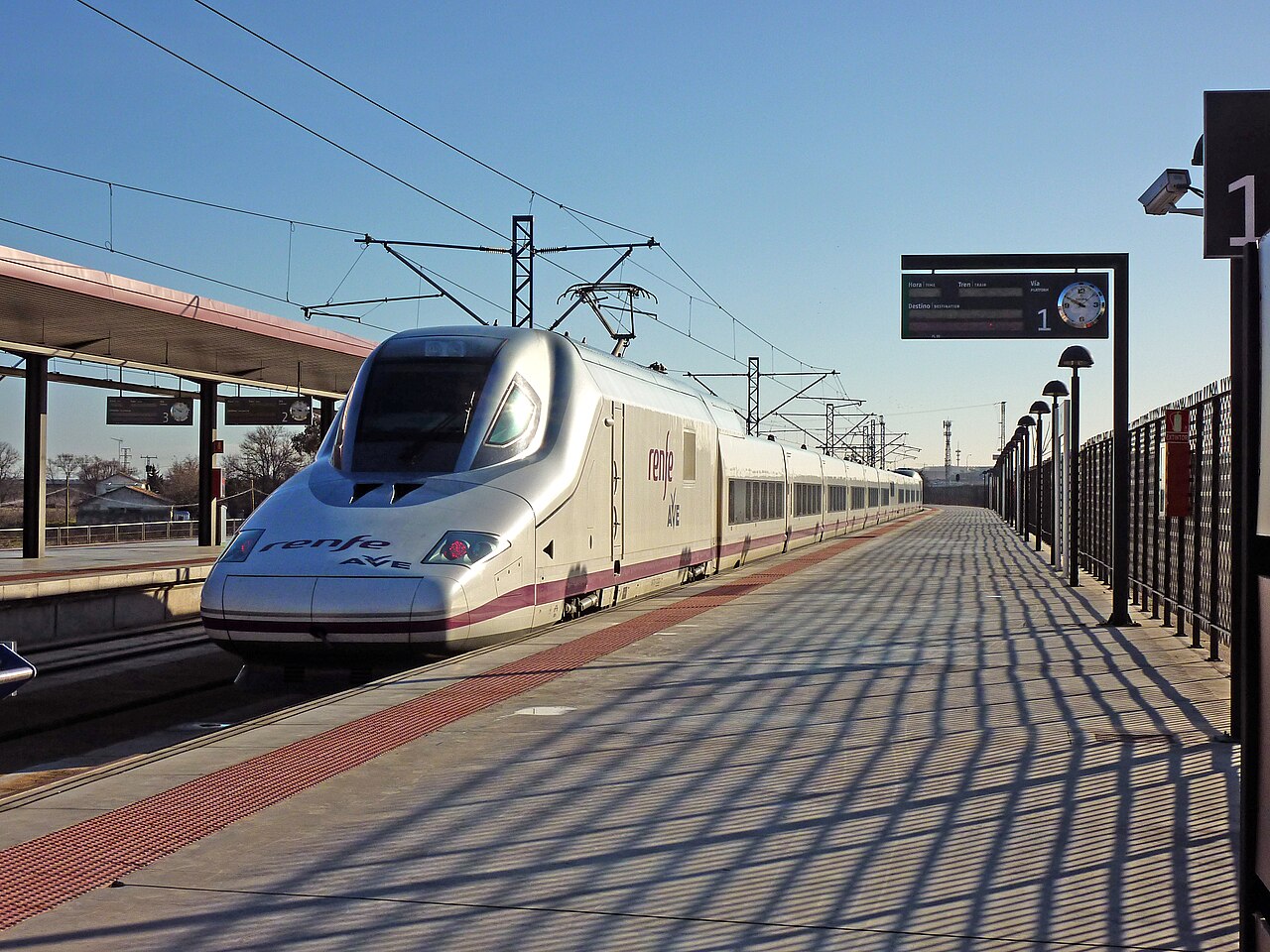
An AVE high-speed train at Toledo station. File photo — not the trains involved in the Urda crash. Photo: Adbar, via Wikimedia Commons.
What happened
On Wednesday morning, October 28, Renfe high-speed train 2080 ran into the back of Iryo train 6076 at kilometre point 118+800 between Mora and Urda, in Toledo province, south of Madrid. The crash happened at 8:53 a.m. local time, and two Iryo carriages fell down an embankment. The trains carried 544 people — 397 on the Renfe service and 147 on the Iryo service, including a newborn baby.
When we first reported the crash, the toll stood at at least 68. On Thursday it moved to 69: The Times reports the extra victim's body was recovered Wednesday night, and García-Page confirmed 69 after an emergency meeting in Toledo on Thursday morning. Regional spokesperson Esther Padilla said 69 is confirmed but could still rise.
There was a brief scare over a higher number. The rail accident investigation commission, the CIAF — now part of the independent authority AITAT — briefly showed 74 dead in its case file on Thursday afternoon, then corrected it to 69. The file, number 146/2026, classes the crash as a "serious accident" and stresses that its initial data may change and the cause has not yet been established.
Latest verified facts
The timeline starts at about 8:30 a.m. Wednesday, when a computer failure knocked out the LZB automatic safety system across roughly 63 kilometres of the Madrid-Seville line. Six trains stopped, and Adif's control centre at Madrid-Atocha took manual control. At 8:36 a.m., according to audio published by El País and TVE, the Renfe driver was cleared to restart at normal speed — even though the Iryo train was still ahead at a red signal, and even though the degraded-system protocol required trains to move on sight at no more than 40 km/h. Seventeen minutes later the Renfe train hit the Iryo train at a reported speed of around 200 km/h.
Puente has not softened his language: he said Adif's control centre let stopped trains move on normally after the signalling failure, against the 40 km/h rule, and called the decision to authorize movement despite a red signal one made "under inexplicable circumstances." An AITAT team has been at the site since the morning of the crash.
Of the 110 injured people treated in the region's hospitals, 60 have been discharged and about 50 remain in hospital, 15 in critical condition. The region's High Court says 48 autopsies had been carried out by Thursday evening, and five victims have been identified by fingerprint. Relatives have filed 70 missing-person reports; two of the people reported missing have been found alive. Among those killed, Spanish media have named former labour minister Fátima Báñez, 59; long jumper Julieta Gallego, 24; and the AVE's driver, Antonio Acedo. Spain's Foreign Ministry says 42 foreign nationals from seven countries were on the trains: one, a 32-year-old Argentine woman, died, seven were injured, ten were unhurt, and the situation of 24 is still unknown.
Why it matters
This is no longer just a story about a signalling failure. Signalling systems fail — that is precisely why degraded-mode rules exist, and why the 40 km/h limit exists. The question at the heart of this investigation is why the backup rule, designed for exactly this failure, was apparently set aside for a train running at close to full speed toward a stopped train it could not see. That distinction matters for every high-speed network in the world, including the ones the United States is still building: automation does not remove human decisions, it moves them into control rooms, where a single clearance can matter more than any single piece of hardware.
Impact on the USA and the world
For American readers, the Urda crash lands in a year when Spain has already suffered one deadly high-speed disaster — the January crash near Adamuz, in Córdoba, which killed 46 people. Two fatal high-speed crashes in nine months on one of Europe's most developed rail networks is the kind of record that shakes confidence far beyond Spain's borders. And the human link is direct: 42 foreign nationals from seven countries were caught up in this crash, on a system millions of American and international travellers use simply to get from one city to the next.
Politically, the crash has already become a fight. Prime Minister Pedro Sánchez promised to clarify it "down to the last detail" and announced three days of national mourning from October 29 to 31. Opposition leader Alberto Núñez Feijóo has demanded immediate investigations and said political responsibility cannot simply be deferred until the investigations conclude. Puente is due before Congress's Permanent Deputation on Tuesday and has promised new public explanations on Friday.
What happens next
Our take: watch three dates, not just one report. Puente's explanations on Friday should clarify what Adif's control centre knew and when. His appearance on Tuesday will put the political questions in public. And the AITAT preliminary findings will carry the technical weight: the black-box data, the control-centre recordings, and the exact sequence from the 8:30 a.m. failure to the 8:53 a.m. impact. Until then, the toll remains provisional — 69 confirmed, not final — with 15 people still in critical condition and families waiting on dozens of missing-person reports.
Sources
The Times (October 29, 2026); EFE via Infobae and Servimedia on the CIAF file correction; elDiario.es and Europa Press on the toll and hospital figures; RTVE and Cadena SER on the investigation; El País and TVE audio on the 8:36 a.m. clearance; statements by Óscar Puente, Pedro Sánchez, Emiliano García-Page, and Alberto Núñez Feijóo.