
In 60 seconds: The Senate voted 50–46 on Thursday to terminate the national emergency behind President Donald Trump's tariffs on Canada, with four Republicans breaking ranks — but the tariffs stay in place for now, because Trump has promised a veto and supporters don't have the two-thirds majority needed to override one.
- The Senate voted 50–46 on October 29 to end the emergency declaration underpinning the Canada tariffs.
- Four Republicans — Collins, McConnell, Murkowski and Paul — joined Democrats; Sen. Tim Kaine sponsored the resolution.
- It was Congress's second tariff rebuke in two days, after the Senate blocked Brazil tariffs on October 28.
- The House passed a similar resolution 219–211 in February, but identical text plus a presidential signature — or a veto-proof majority — is still required.
- The tariffs remain in effect while the fight plays out, and the Supreme Court is separately weighing whether the emergency powers behind them are lawful at all.
Here's the thing: this was the most significant Republican break with Trump of his second term, and it still changes nothing tomorrow morning. That's the strange math of this vote — a genuine rebuke that leaves every tariff exactly where it was.
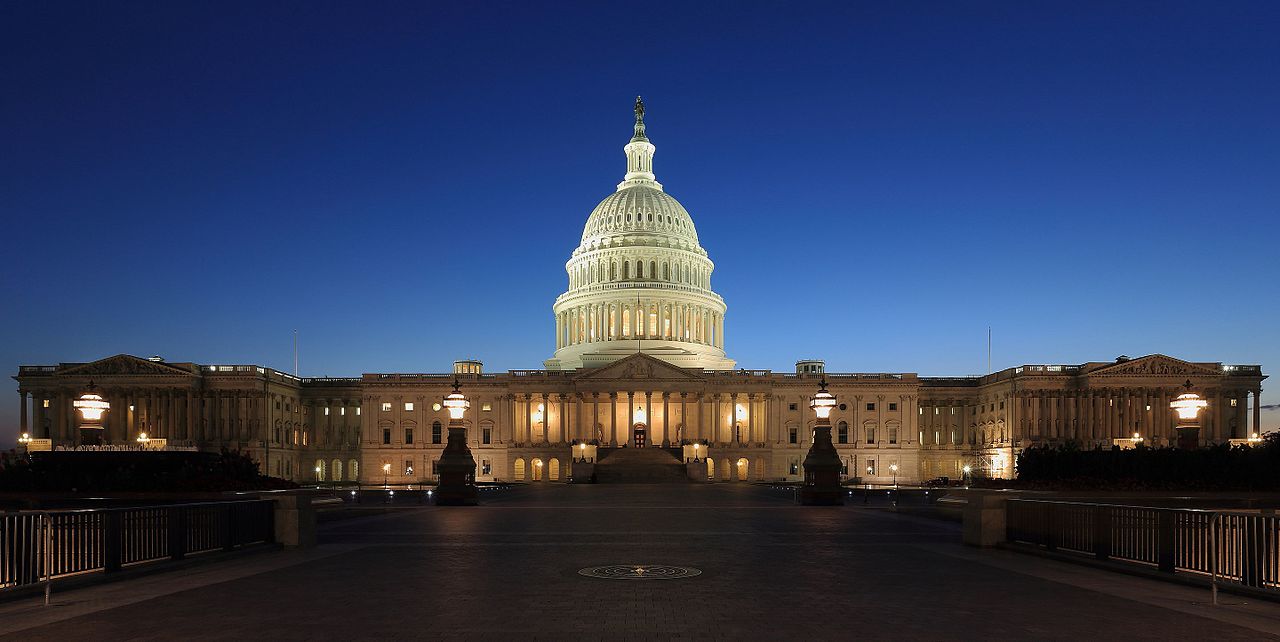
The U.S. Capitol at dusk. The Senate's 50–46 vote was its second tariff rebuke of Trump in two days. Photo: Martin Falbisoner / Wikimedia Commons (CC BY-SA 3.0)
What happened
The Senate voted 50–46 on October 29 to terminate the national emergency President Donald Trump invoked to impose steep tariffs on Canadian goods. Four Republicans — Susan Collins of Maine, Mitch McConnell of Kentucky, Lisa Murkowski of Alaska and Rand Paul of Kentucky — joined Democrats in support. The resolution was sponsored by Democratic Sen. Tim Kaine of Virginia.
Kaine argued on the floor that Trump had stretched the emergency law "far beyond the language of the statute." On the fentanyl rationale for the tariffs, he was blunter: "It is ridiculous to say that fentanyl is an emergency with respect to Canada. It's a pretext that is just being used to pour more and more tariffs onto Canada."
The numbers back him up, at least on the border claim. According to U.S. Customs and Border Protection figures cited in the debate, less than 1 percent of fentanyl seizures this year occurred along the northern border — about 66 pounds in total. The overwhelming share comes through the southern border.
Latest verified facts
The Canada tariffs began in February, when Trump imposed 25 percent duties under the International Emergency Economic Powers Act (IEEPA), citing fentanyl flows. He raised them to 35 percent in August, then threatened another 10 percent increase last week after Ontario's provincial government aired a television ad during the World Series featuring a 1987 Ronald Reagan speech warning that tariffs "lead to retaliation and shrinking markets." Trump called the ad a "serious misrepresentation of the facts" and a "hostile act."
Just days before the vote, the White House eased some tariffs affecting Maine's border economy after a request from Collins, whose state is deeply integrated with Canada. And the Senate's Canada vote followed its October 28 vote to block tariffs on Brazilian goods — two bipartisan rebukes in as many days, five days before the November 3 midterm elections.
Trump, for his part, has made his position plain. He has said he "will never sign" a resolution ending the tariffs, and warned on social media that "any Republican, in the House or the Senate, that votes against TARIFFS will seriously suffer the consequences come Election time, and that includes Primaries!"
Why it matters
Politico called the vote the most significant rebuke to Trump that congressional Republicans have yet mustered in his second term, and the timing is no accident. With midterms five days away, senators in border states are feeling the tariff war at home. Collins's Maine seat is one of the cycle's most contested races — her Democratic challenger, Troy Jackson, has made the trade war a central campaign issue — and Maine's blueberry, potato and paper industries all rely on Canadian inputs.
More broadly, the vote puts every member of Congress on the record about a policy that has defined Trump's economic agenda. Even senators who know a veto is coming are now forced to choose, in public, between party loyalty and the businesses in their states paying the duties.
Impact on the USA and the world
For American shoppers and businesses, nothing changes yet — and that's the point worth understanding. Tariffs are paid by U.S. importers, not by Canada, and those costs filter into prices for everything from lumber and auto parts to groceries. Canada, meanwhile, has slipped into a technical recession after two quarters of contraction, with roughly 70 percent of its exports headed to the United States.
The vote also lands alongside live negotiations: a U.S.–Canada deal on steel and auto tariffs could still land before Election Day, according to Reuters reporting this week. And the economic stakes run wider than Canada — the U.S. economy grew 3.4% in the third quarter even as inflation heated up again, a backdrop that makes every tariff fight a pocketbook fight too.
What happens next
Three paths, none of them fast. First, the House must agree on identical text — it passed its own version 219–211 back in February, with six Republicans joining Democrats — and then the resolution goes to Trump's desk, where a veto is expected. Overriding it would take two-thirds of both chambers, a bar supporters plainly don't clear today.
Second, the Supreme Court is separately weighing whether IEEPA even authorizes these tariffs. A ruling against the administration would do what Congress cannot — and would blow a hole in federal revenue markets have grown accustomed to.
Third, November 3 itself. If voters punish the tariff policy at the ballot box, the political calculus for a veto override shifts overnight. Our take: watch the House's next move and the court's docket, not the vote tally — the 50–46 number was the signal, but either of those two venues is where the tariffs actually live or die.
Sources: The Hill (vote tally and sponsor, via syndication); Reuters (February House vote, 219–211); Politico (rebuke characterization); U.S. Customs and Border Protection seizure figures; Senate floor remarks by Sen. Tim Kaine.